The first and only treatment to show superior efficacy vs standard single-agent chemotherapy in FRα-positive* PROC1-3
*FRα positive is defined as ≥75% of viable tumor cells with moderate (2+) and/or strong (3+) membrane staining based on an IHC assay.4
MIRASOL: The first, only, and largest positive phase 3 study specifically for patients with FRα-positive PROC VS STANDARD CHEMOTHERAPY1-3,5*
MIRASOL was a confirmatory, global, multicenter, randomized, open-label study evaluating the efficacy and safety of ELAHERE vs investigator's choice chemotherapy in FRα-positive, platinum-resistant ovarian cancer1,2†
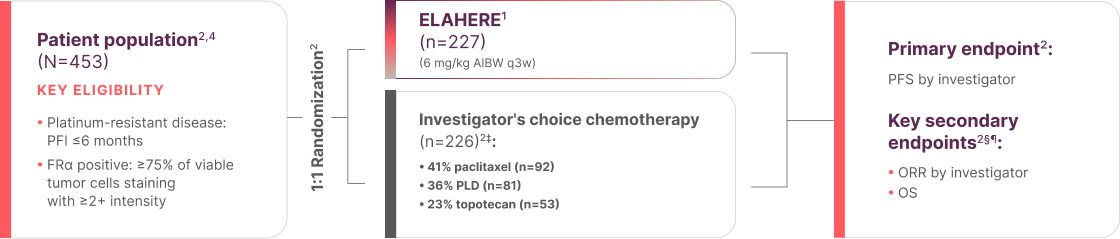
*Versus single-agent chemotherapy.
†Includes epithelial ovarian, fallopian tube, or primary peritoneal cancer.1
‡Paclitaxel was administered intravenously on days 1, 8, 15, and 22 of a 4-week cycle (80 mg/m2 of BSA); PLD was administered intravenously on day 1 of a 4-week cycle (40 mg/m2); and topotecan was administered intravenously on days 1, 8, and 15 of a 4-week cycle (4 mg/m2) or was administered intravenously on days 1 to 5 of a 3-week cycle (1.25 mg/m2).2
§Since the primary endpoint was statistically significant, a hierarchical testing procedure was used to control the study-wise error rate for key secondary endpoints of ORR and OS, in that order.2
¶Due to there being no procedure in place to control the type I error on other secondary efficacy endpoints, all P values for treatment comparison on other secondary efficacy endpoints will be for information only and will be considered as nominal.2,6
Key eligibility criteria for MIRASOL
- Patients received 1 to 3 lines of prior systemic therapy; prior bevacizumab and PARPi therapy were allowed2
- Patients with BRCA mutations were allowed in the study2
- Patients with primary platinum-refractory disease, defined as PFI of <3 months, were excluded2,7
- Patients were excluded if they had corneal disorders, ocular conditions requiring ongoing treatment, Grade >1 peripheral neuropathy, or noninfectious interstitial lung disease1
453 PARTICIPANTS REPRESENTING A RANGE OF DEMOGRAPHICS1,2
Characteristics2
Elahere,n (%)(n=227)
Standard chemotherapy,n (%)(n=226)
Median age (range)
Age in years
64 (32-88)
62 (29-87)
Stage at initial diagnosis
I-II
9 (4)
9 (4)
III
137 (60)
147 (65)
IV
76 (34)
65 (29)
BRCA mutation
Yes
33 (15)
36 (16)
No or unknown
198 (87)
190 (84)
Prior exposure
Bevacizumab
138 (61)
143 (63)
PARPi
124 (55)
127 (56)
Taxanes
227 (100)
224 (99)
Primary platinum-free interval
≤12 months
146 (64)
142 (63)
>12 months
80 (35)
84 (37)
Platinum-free interval
≤3 months
88 (39)
99 (44)
>3 to ≤6 months
138 (61)
124 (55)
Number of prior systematic therapies
1
29 (13)
34 (15)
2
90 (40)
88 (39)
3
108 (48)
104 (46)
ECOG PS
0
130 (57)
120 (53)
1
97 (43)
101 (45)
2
0
3 (1)
Missing data
0
2 (1)
Race
White
156 (69)
145 (64)
Black
8 (4)
5 (2)
Asian
28 (12)
25 (11)
Not reported
32 (14)
49 (22)
other
3 (1)
2 (1)
Ethnicity
Hispanic or Latino
12 (5)
15 (7)
Not Hispanic or Latino
177 (78)
163 (72)
Unknown
2 (1)
2 (1)
Not reported
35 (15)
45 (20)
Missing data
1 (<1)
1 (<1)
In the overall MIRASOL patient population, 14% of patients had received 1 prior line of systemic therapy, 39% had received 2 prior lines, and 47% had received 3 prior lines. Additionally, 37% of patients had received prior systemic therapy for platinum-resistant disease, 62% had received prior bevacizumab, and 55% had received a prior PARPi.1
ECOG PS=Eastern Cooperative Oncology Group performance status.